This spring, members of the MASFEC & FCSN team brought our work to panels, professional development sessions, and statewide conferences — sharing what we know, learning from colleagues across the field, and elevating the family voice in conversations where it matters most. Here’s a look at where we’ve been.
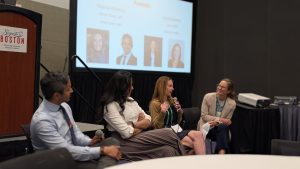
FCSN’s Wendi Hoffer, second from right, participating in the PAS panel
Family Partnerships in the Age of AI and Social Media Pediatric Academic Societies (PAS) Annual Conference, April 27, 2026
FCSN’s Wendi Hoffer joined a panel at the Pediatric Academic Societies Annual Meeting to speak as a parent of a medically complex child about what real family partnership in healthcare looks like in the age of social media and artificial intelligence — and what gets in the way of it.
One key message: when families arrive at appointments armed with research they’ve gathered online between visits, they need to feel validated, not dismissed. Families turn to social media and AI because they are searching for solutions — and when clinicians treat that effort as a nuisance rather than an opportunity, it erodes the trust that good care depends on. The more productive path is for practitioners to meet families where they are: acknowledging their research, contextualizing it within their child’s full medical history, and building the kind of partnership that means families don’t have to search for answers alone.
The same dynamic plays out every day in schools. Families — especially those of students with disabilities or complex learning needs — are often doing significant independent research between IEP meetings, school conferences, and check-ins. They arrive having read about specific interventions, accommodations, or diagnoses in parent Facebook groups, online forums, or AI tools. When educators respond with defensiveness or dismissal, the message families receive is that their effort isn’t welcome. When educators respond with curiosity — acknowledging what families have found, contextualizing it within what the school knows about the child, and treating that research as evidence of deep investment — the relationship strengthens. The question for educators, just as for clinicians, is not whether families will turn to outside sources for information and reassurance. They will. The question is whether the partnership is strong enough that families feel they can bring what they find back to the table.
Bridging the Gaps: Early Intervention to Pre-K MEIC Annual Conference, May 4–5, 2026
FCSN’s Karen Lopez and Pat Cameron presented at the 2026 Annual Massachusetts Early Intervention Consortium (MEIC) Conference, joining a two-day gathering of early intervention professionals from across the state. Their session, Bridging the Gaps: Improving Transitions from EI to Pre-K, addressed one of the most critical — and often most challenging — moments in a young child’s educational journey: the transition out of Early Intervention and into preschool special education services. For families of children with disabilities, this transition can feel abrupt and disorienting, and Karen and Pat brought FCSN’s family-centered perspective to a room of practitioners working to make that handoff smoother and more supportive.
FCSN’s Work with the Office of Language Acquisition Highlighted at MATSOL MATSOL Annual Conference, May 27–29, 2026
FCSN’s ongoing work with the Office of Language Acquisition was highlighted at this year’s Massachusetts Association of Teachers of Speakers of Other Languages (MATSOL) conference during conversations about English Learners with Disabilities (ELSWD) and resources for families. We were glad to see this work resonating with the broader field and look forward to continuing to build on these partnerships.
Partnerships with Immigrant Families: Professional Development in Revere Revere High School, June 9, 2026
FCSN’s Ann Teng led a two-hour professional development session at Revere High School on building partnerships with immigrant families — bringing research-based strategies and real-world expertise to a room of 20 professionals including Dr. Lourenco Garcia (Assistant Superintendent of Equity and Inclusion and Chair of the Equity Advisory Board of Revere Public Schools), family engagement coordinators & liaisons, and multilingual coaches. The session reflected FCSN’s commitment to meeting educators where they are and equipping them with the tools to build trust with the families who have historically faced the greatest barriers to engagement.


